

"Permanent residency status" is the type of U.S. immigration status which permits a foreign national to reside permanently in the U.S. A foreign national with permanent residency status has similar rights to a U.S. citizen (e.g., the right to accept employment) with some exceptions (e.g., only a U.S. citizen can vote in the vast majority of elections). Obtaining permanent residency status is often a precursor to obtaining U.S. citizenship.
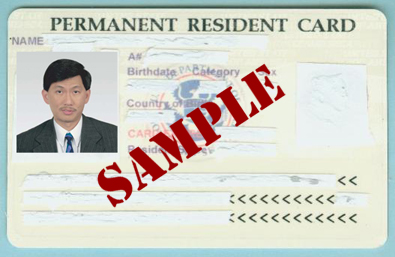
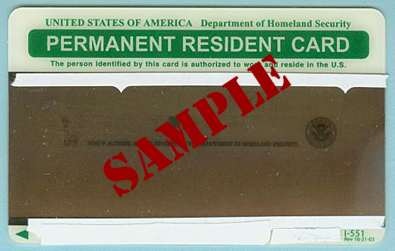
Permanent residency status in the United States is often referred to as having a "green card", a name which was given to the document issued by the U.S. government to persons who attained permanent residency status. Although the document is no longer green, the term is still widely used. Technically, a person in this status is referred to as a "Resident Alien" by the USCIS.
Permanent residency status is also known as an "Immigrant Visa". "Nonimmigrant Visas", on the other hand, refer to temporary visas.
Obtaining permanent residency status in the U.S. is often a long and difficult process. There are, however, a number of different ways of obtaining it. This section lists the major avenues for obtaining permanent residency, below, which are links to other pages in this website. In addition, you may wish to review the List of of primary avenues to U.S. Permanent Residency (“Green Card” status).
|
Example Green Card: Front |
 |
|
Example Green Card: Back |
 |



Doctor with GC
My Dad is an experienced cardio-thoracic surgeon in India. I am planning to apply for a green card for him, so he can work here. He plans to take the USMLE over the next year. Can he immediately start working as a doctor after he passes these exams? or does he have to do residency?
License Requirements for Physicians
Re-entry permit
My mother-in-law has lost her green card but she has a re-entry permit. My husband has applied for a replacement green card but we have only received a receipt letter from the INS. Can she come to the U.S. with only her re-entry permit? She has been out of U.S. for the past 6 months already. Please reply to my question ASAP.
filed for re-entry permit...now what?
hi,
i work in manila and i stay out most of the year. I was in california several months ago and i applied for a re-entry permit, i filled up the application, and sent the form along with the monetary fee. about a week after i did that, i flew back to manila. then they sent a form to my house in los angeles requesting that i've to appear for my appointment and biometrics. my mom mailed me the form and i'm about to go back to los angeles again in a week or so. what will happen when i get to the airport?will they hold me in customs for brief questioning? or do i present to them the form that i applied for a re-entry permit?
after the airport is done, what would be my next step so i could secure my permit?
how to keep the green card
If u enter every 6 months can ukeep your green card without living in the U.S???
What if the officer is asking about where do u live and work?
thanks
Immigration Inspector always has discretion
Even if you enter the U.S. every six months, the Immigration Inspector still has the discretion to determine whether you have abandoned your intent to reside permanently in the U.S., taking all of the circumstances into account. For individuals who intend to reside permanently in the U.S., and wish to secure their green card, it is advisable to obtain a Reentry Permit, under those circumstances, and to take standard precautions: Keeping your Green Card
Is the Reentry Permit valid for multiple reentries?
I have recently started a Master's degree in Costa Rica that will last for two years. I had not planned on staying out of the US for the entire two years, but instead hope to travel back to the US at least once a year or even every six months during my breaks from school. If I apply for the Reentry Permit does that give me unlimited entries into the United states without losing my green card or can it only be used once and then afterwards I would have to apply for another for the next time I came home? Would you advise applying for the Permit even if I plan on being out of the US for no longer than 6 months at a time?
Thank you for your attention.
Reentry Permits Multiple Entries
Normally, reentry permits are issued for multiple entries. Second, even if one will be re-entering the U.S. within 6 month intervals, it is sometimes advisable to obtain a reentry permit because the Immigration Inspector always has the discretion to determine whether one has actually abandoned one's intent to reside permanently in the U.S. taking into account all of the circumstances.
re-entry permit and second trip shorter than 1 year
scennario: spouse of US citizen; US citizen is working for US company, assigned to overseas job for 2-3 years, extendable to 5; spouse is US permanent resident for 17 years; have 3 sons (US citizens), along on the overseas assignment.
Family still has their home, not rented, with house-sitter, so as to be available short notice and for extended home leaves; family paying all home bills and taxes; spouse maintained professional subscriptions and family has maintained memberships in organisations
Due to the initial time of relocation and poor advice about re-entry permit, we took the first home leave as a family after 5 months; spouse applied for re-entry permit as next home leave was going to be more than 12 months later. Third trip, whether home leave or move home, is scheduled for less than 12 months from the last trip, but cummulatively more than 2 years for the two trips together
.
Does the spouse have to return prior to the lapse of the two years of validity of the re-entry permit, or does the "clock" reset, as the re-entry permit had been obtained especially for the long trip.
Gren card for my mom
Hello,
I've been living in US for more than 10 years and I'm going to apply for citizenship based on 5 years green card. I was planning to bring my mom here once I become a citizen. However, she just had a heart attack and I worry that I cannot wait long... What should I do to get her here permanently?
She visited me two times on tourist visa, but I do not think that her health allows her to travel anymore... I have two kids (1 is US citizen) and I am married to US citizen. Thanks you.
Surrendering Green Card
I got my green card towards the end of 2007 and then got offered and took up a job in Canada, returning to the US every now and then for personal reasons - however, my work was based in Canada, and I have a Canadian work permit. I never applied for the US re-entry permit and every time I entered the US I was taken aside for further questioning about my residency status. I was told that I would have to apply for my re-entry permit within a year, which has now passed. I've not returned to the US since last summer, and am not sure what I should do when I next visit there, or if immigration will even allow me in.
I still have a US mailing address, bank account, IRA, driving license, but have sold my property. Also, my employer has offered to sponsor me for my permanent residency here in Canada. I am not sure what to do about my green card - ideally surrender it, and still be able to enter the US via the visa waiver program, seeing as I am a UK citizen.
Not sure what I should do - can I surrender it in Toronto at the consulate? Confusing, but any perspective or advice would help!
different name
my philippine passport says my whole name before i got married but i applied for amendment to change my last name to my married name, they did it but the middle name retained my last name before i got married. now my green card says my mothers maiden name as my middle name. would it be a problem when i reentry the us. i have my marriage certificate that says my full name matches what its in my passport. its just that in philippine you have to always use your father's last name as your middle initial name when you get married. i used my prevoius middle name as my middle name now on my green card. its only worrying me that they differ on my middle initial on my green card and my middle initial on the amendment stamp on my philippine passport although the first page still has states my name mathces what was my name beofre i got married. i mean im the same person. is that a problem?
Returning Resident Visa or H1B?
Both me and my wife got the Green Card in Mar 2002. In Jan 2006, my wife took a trip to India with the intention of returning back with in a short period of time but it so happened that my wife's father suffered a major stroke in March 2006 due to which he is still paralyzed. And then later that year my father also was diagnosed of late stage cancer. Consequently, she could never return back to US since then. Also, I had to return to my home country in Nov 2006, but before leaving US I applied for a re-entry permit. In Feb 2009, I returned back to US on the basis of re-entry permit. So, now the current situation is that I am in US with a valid GC but my wife and the kids (who are US citizens by birth) are in India.
I want to know, what is the best way of getting my wife and kids to US as it is time for the kids to start attending school here in US. Would returning resident visa work for her. Or, should I apply for a fresh H1B visa through my company here in US. She has been on the payroll of this US company since 2002. We have been maintaining US bank accounts, credit cards, drivers license, car here in US, a US cell phone number and also been paying US taxes. Please advise. Thanks.
Re-Entry Permit for Kids below 14 years old
I am presently residing here at Jacksonville, Florida and I got my green card last June 16, 2007. I am a single working mother with two (2) kids ages 9 and 6. I am taking up my B.S. Nursing course at a university here in Florida. Since I would be very busy this coming semester due to my part-time work and school and no one would be taking care of my kids, I am planning to send them back to the Philippines to study there for the meantime until I finished my degree course here. I am planning to get them back here in the US after one (1) year but not more than two (2) years. Since my kids are also green card holders, would there be any problem for my kids getting back here in the states not affecting the status of their green cards? Do I need to fill-up some forms like “re-entry permit” so that I would not be encountering problems later? I hope you could help me.
Kids below 14 years old should also get reentry permits
To protect their U.S. Permanent Residency, the safest course is to obtain reentry permits even for kids below 14 years of age, who will be absent from the U.S. for more than one year (if they intend to reside permanently in the U.S.).